

Commercial Kitchen Equipment Selection: A Lifecycle Decision
In commercial kitchens, the most economical equipment can often turn out to be the most expensive. Maybe the fryer with the lowest price tag looked great 18 months ago, but when it cannot recover during a peak Friday rush, it becomes a liability. The next basket drops into oil 20 degrees too cold, the line backs up, tickets go unfulfilled, and revenue is lost.
All of these issues can, of course, be mitigated with the right equipment selection. But that’s not always as easy as it seems.
Why Equipment Selection Has Gotten Harder
Rising equipment costs have compressed the margin between what operators want to spec and what the budget will carry. Lead times on many product lines remain unpredictable, forcing faster decisions with less comparison time. The pressure to accept the lowest bid has never been stronger. But equipment that enters a kitchen on price alone tends to stay in service long after the savings have reversed.
Total Cost of Ownership Over the Equipment Life
Upfront price represents a fraction of what a piece of equipment will cost over its service life. Maintenance intervals, parts availability, energy draw, and projected lifespan all contribute to the real number. Operators who calculate total cost of ownership before signing a purchase order consistently avoid the mid-lifecycle replacement that turns the cheaper unit into the most expensive one in the kitchen. For operators weighing acquisition cost against cash flow, financing and leasing options can spread that investment without forcing a lower-spec compromise.
Durability and Warranty as Risk Transfer
A warranty is a risk-transfer mechanism. The length and scope of coverage signal how much operational risk the manufacturer is willing to absorb. Operators should compare what is covered, including compressors, labor, controls, and structural components, not just the term length. A five-year compressor warranty on a walk-in tells a different story than a one-year parts-only term. Reading the exclusions matters as much as reading the headline coverage.
Energy Efficiency as a Recurring Cost
Energy-efficient equipment reduces utility expenses every month it operates. Over a ten-year service life, the difference between an Energy Star-certified unit and a baseline model can exceed the original price gap several times over. Operators evaluating efficiency should request Energy Guide data and compare annual kWh or BTU figures rather than relying on marketing claims.
NSF Compliance Sets the Floor
NSF certification confirms that a unit meets established sanitation and safety standards for commercial food environments. It is not a premium add-on. Operators should verify NSF/ANSI certification on every unit entering the kitchen, with particular attention to NSF/ANSI 2 for food handling equipment and NSF/ANSI 4 for cooking equipment. Jurisdictions where health inspectors verify certification during routine visits leave no room for non-certified alternatives. The cost of replacing a non-compliant unit after installation far exceeds the price difference at the spec stage.
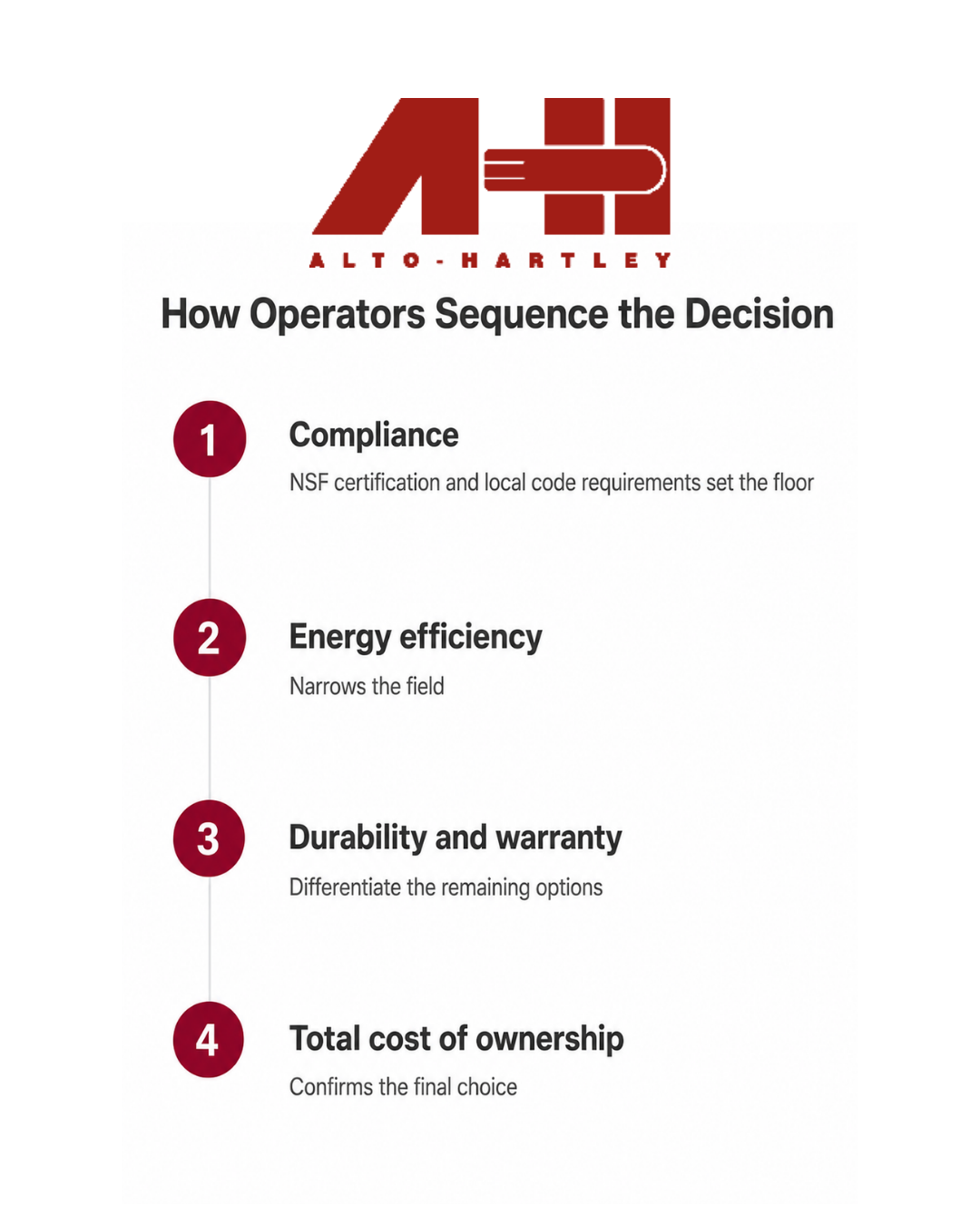 The Process for Selecting the Right Commercial Kitchen Equipment
In practice, most experienced operators begin with compliance. NSF certification and local code requirements set the floor. Energy efficiency narrows the field. Durability and warranty terms differentiate what remains. Total cost of ownership confirms the final choice. Starting with price alone removes too many of the right options too early. The operators who get the best outcomes treat selection as a sequence. A structured approach to working with a kitchen dealer supports that discipline, and browsing equipment by manufacturer gives operators the side-by-side view that sequencing requires.
Frequently Asked Questions About Selecting Foodservice Equipment
What is the most common mistake in commercial kitchen equipment selection?
Choosing on the upfront price alone. The lowest-bid unit often carries higher energy costs, shorter warranty coverage, and earlier replacement cycles. Over time, these factors raise the total cost of ownership above better-specified alternatives.
Does NSF certification affect equipment resale value?
Yes. NSF-certified units hold resale value more consistently because secondary-market buyers face the same compliance requirements. Non-certified equipment is harder to place and typically sells at a steeper discount.
How much can Energy Star equipment save compared to standard models?
Savings vary by equipment category, but Energy Star estimates that a fully certified commercial kitchen suite can reduce energy costs by roughly $4,000 per year compared to standard alternatives.
Alto-Hartley works with operators across the DMV to select equipment that balances performance, compliance, and long-term value. We’re here to help you with your selection process when you’re ready.
