
What a Full-Service Commercial Kitchen Partner Should Own
Most commercial kitchen projects do not fail within a phase. They fail at the handoff between two of them. Mid-build, a prep sink moves four feet to clear a column. The revised drawing reaches the general contractor, but the fabrication shop is still working from the old one, so the custom counter arrives sized for a sink that has moved. Each party did its work, and the project still absorbed a change order.
That gap is the work a commercial kitchen project partner is hired to own. Layout, equipment, utilities, fabrication, and installation each have a responsible party on paper. The partner holds the connections between them, so a change made in one place reaches every place it affects.
Fragmented vendor management creates gaps
A single kitchen build can involve a foodservice consultant, an architect, a general contractor, the mechanical, electrical, and plumbing trades, a fabricator, and equipment from dozens of manufacturers. Each party manages its own scope. Each scope also ends at a boundary, and the boundaries are where information gets lost.
Operators feel those boundaries as unclear ownership, missed handoffs, deliveries arriving before the site is ready, change orders, and a budget that drifts further from the approved number with each revision. None of these problems belongs to a single trade, which is why no single trade resolves them.
The principle holds at every project size. On a hospital central kitchen project recently profiled by Foodservice Equipment & Supplies, the equipment dealer put it plainly: “When equipment meets utility, someone is responsible for every detail.” The same dealer noted that settling responsibility early is what prevents confusion later in the project.
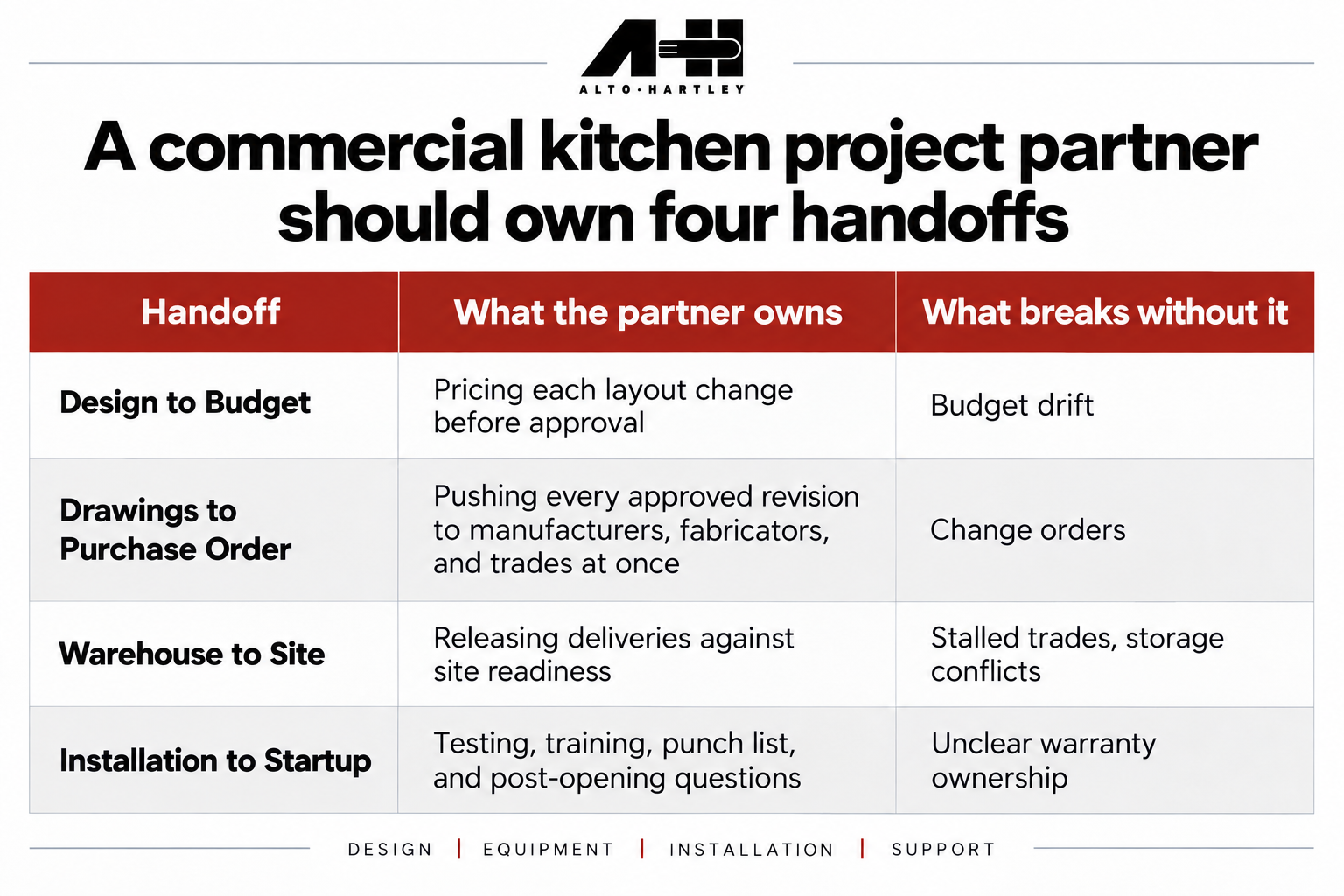
A commercial kitchen project partner should own four handoffs
The partner owns the link between design and budget
The first handoff happens when a drawing becomes a number. Every layout decision carries equipment, fabrication, and utility costs, and those costs need to be traced at the moment the decision is made.
A strong partner prices the plan as it develops. When the operator moves a station, extends a hood, or changes a cooking platform, the partner shows how that change affects equipment cost, custom fabrication, and utility requirements before it is approved. That discipline keeps the budget tied to the current drawing, and it is the most reliable defense against budget drift.
Alto-Hartley carries projects from design drafting through procurement and installation, across negotiated work, contract-bid work, and equipment replacement. Design and purchasing decisions remain within a single workflow.
The partner owns the order once the drawings are approved
Procurement is where a revision either reaches every party or quietly misses one. Purchase orders, shop drawings for custom fabrication, and utility schedules all need to match the same revision of the plan.
The partner owns that match. Every approved change should reach the manufacturer, the fabricator, and the trades roughing in utilities simultaneously. That is the step the sink in the opening example missed.
Custom fabrication raises the stakes because stainless steel counters and millwork are built to fit one specific layout. The partner should bring the fabricator into the same revision loop as the equipment orders. Alto-Hartley is a dealer and distributor for more than 500 U.S. manufacturers, and each project’s single point of contact serves as the liaison to every other vendor involved, including fabricators. For the full phase-by-phase sequence, the 7 steps of the commercial kitchen project process lays out each stage in order.
The partner owns the schedule from warehouse to site
Delivery timing is the handoff operators notice first, usually on the day a truck arrives at a site that cannot accept it. Early deliveries need storage and protection the site may not have, and late deliveries stall the trades waiting to make connections.
A partner owns that timing by tracking site readiness alongside manufacturer lead times and releasing deliveries when the site is ready for them. Alto-Hartley receives all equipment orders at its warehouse and consolidates delivery to the project location. A consolidated delivery plan is far easier to match to construction progress than a stream of separate shipments.
The partner owns startup and what comes after
Installation is the last physical handoff, and commissioning confirms it worked. A partner who carried the project this far should see it through equipment testing, utility verification, staff training on new equipment, and the punch list that follows.
Ownership continues past opening day. Questions about warranty, calibration, or performance tend to surface in the first months of service, and operators should know exactly who answers them. Alto-Hartley maintains client relationships after projects are complete to make sure clients are satisfied with the result.
How a commercial kitchen project partner connects every handoff
Each handoff above depends on the same thing: one person who sees the whole project and is accountable for moving information across it. Alto-Hartley assigns every project a single point of contact who manages all aspects of the work and serves as the liaison to all other vendors and service providers involved.
That structure is what makes a partner full-service. It turns a set of separate scopes into one project, and it is the standard worth holding any partner to. For the questions to ask before signing with a dealer, how to evaluate a commercial kitchen equipment partner before you commit covers the diligence side of the decision.
More than 40 years of foodservice projects across the DMV stand behind that model. Good foodservice project management comes down to knowing who owns each handoff before the first drawing is final.
Frequently Asked Questions About Commercial Kitchen Project Partners
What does a full-service commercial kitchen dealer coordinate? A full-service commercial kitchen dealer coordinates design, budgeting, equipment procurement, custom fabrication, delivery, installation, and commissioning, and manages communication among the trades and vendors at each stage.
Does a commercial kitchen project partner replace the foodservice consultant? On many projects, a foodservice consultant leads design and specification, and the project partner carries procurement, fabrication, delivery, and installation to that specification. The two roles work together, with the partner keeping each stage aligned with the consultant’s plan.
What causes budget drift on a commercial kitchen project? Budget drift usually stems from design changes approved without accounting for their effects on equipment, fabrication, and utilities. Pricing each change as it is made keeps the budget tied to the current plan.
What happens after a commercial kitchen installation is complete? Commissioning follows installation. Equipment is tested, utility connections are verified, staff are trained, and punch-list items are resolved. Operators should also know who handles warranty and performance questions in the months after opening.
When a large-scale project is on the horizon, we can help you plan phasing, coordination, and budget controls as one schedule from the beginning.
