
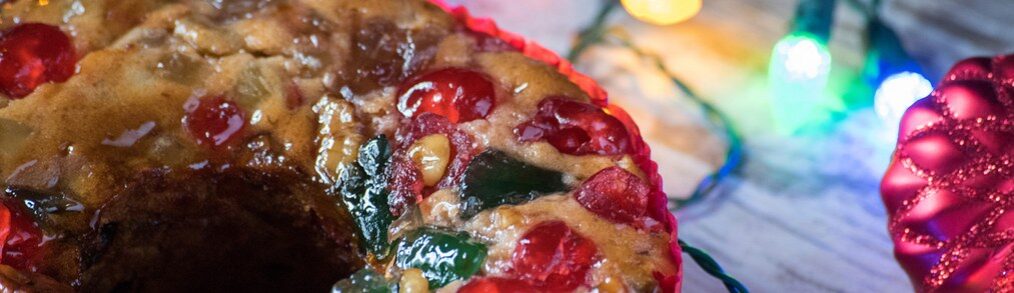
The History of the Fruitcake, the Holiday Dessert Built to Outlast Its Critics
Nothing gets passed around the holiday table quite like a fruitcake joke. Johnny Carson famously quipped that there is only one fruitcake in the entire world, and people keep sending it to each other. The line has aged remarkably well, and so has the fruitcake, which turns out to be the whole point.
Long before it became the season’s favorite regift, fruitcake solved a serious kitchen problem: how to keep the summer harvest around long enough to celebrate with in December. Its story runs from Roman soldiers to medieval bakers to the U.S. Post Office, and it ends somewhere surprisingly familiar to anyone who runs a commercial kitchen during the holidays.
The fruitcake started as a Roman field ration
The earliest ancestor of the fruitcake was built for the battlefield. Romans mixed barley, honey, wine, and dried fruit, often pomegranate seeds, into a dense mash that kept soldiers fueled on the march. Think of it as the original energy bar, minus the wrapper and the marketing.
The version most people would recognize today, a moist, leavened cake studded with fruit and nuts, likely took shape in Europe during the early Middle Ages. Cinnamon, cloves, and nutmeg were signs of culinary sophistication, so bakers worked them into fruited breads and cakes across the continent. Italy’s panettone and Germany’s stollen are close cousins that somehow escaped the family reputation, and plum pudding, another dried-fruit holiday staple, has a long history at the Christmas table of its own.
Sugar turned summer fruit into a Christmas tradition
Fruitcake arrived in America with European colonists, right as cheap sugar from the Caribbean began pouring into New England. Sugar was the secret to preservation. Cooks candied fruit by boiling it in sugar syrup, rolling it in more sugar, and letting it dry, which allowed colonists to save the summer harvest for Christmas baking.
Spirits finished the job. In an era before mechanical refrigeration, a cake that could rest for months was a real asset, and fruitcake devotees still “season” theirs by brushing them with brandy, rum, or, in the American South, bourbon, then wrapping them tightly and tucking them somewhere cool and dark. Several spirit baths later, the cake slices cleaner and tastes better, which makes fruitcake one of the few desserts that improves by being ignored.
The Postal Service made fruitcake famous (and then infamous)
Fruitcake’s big break came by mail. Rural Free Delivery launched in 1896 and Parcel Post followed in 1913, and a dense, nearly indestructible cake turned out to be the perfect mail-order product. Claxton’s of Claxton, Georgia, and Collin Street of Corsicana, Texas, both got their start in that era, and by the early 1900s fruitcake tins were a fixture in American mailrooms.
The affection lasted for decades, and as late as the 1950s the Los Angeles Times called fruitcake a “holiday must.” By 1989, a Mastercard survey found it was the least favorite gift for 75 percent of the people polled. Smithsonian magazine has pointed to mass production as the turning point, since the mail-order cakes of the early 20th century helped create the classic image of a dry, heavy loaf crowded with brightly colored candied fruit.
Old fruitcakes have the receipts
Love it or hate it, the fruitcake has earned its reputation for longevity. Two friends in Iowa have traded the same fruitcake back and forth since the late 1950s. Explorer Robert Falcon Scott left one behind in Antarctica in 1910, and the oldest known survivor was baked in 1878, when Rutherford B. Hayes was president. People have tasted these relics and lived to tell about it, thanks to the mix of sugar, dry ingredients, and high-proof spirits that, as a Colorado State University hospitality professor explains, makes fruitcake one of the longest-lasting foods around. With more than 2 million fruitcakes still sold each year, somebody is clearly eating them.
Fruitcake is the original make-ahead bake
Set the jokes aside and fruitcake is a lesson in planning. It was designed to be made well ahead, stored with care, and served right on schedule. British households even gave the ritual a date: Stir-up Sunday, the last Sunday before Advent, when families traditionally mix their Christmas puddings weeks ahead of the holiday.
That same logic runs every commercial kitchen in December. The operations that handle holiday volume best plan their batch production in advance, protect cold storage space for prepped items, and make sure their baking and holding capacity matches the rush before it arrives. For more ways to stay ahead of the season, these holiday prep tips for foodservice operations are a good place to start. The fruitcake figured all of this out centuries ago, and it has the shelf life to prove it.
Whether your kitchen is gearing up for holiday volume or planning upgrades for the new year, we are here to help when you are ready. Visit the Alto-Hartley showroom in Alexandria, VA, to see equipment in person. We promise not to send you home with a fruitcake.
